
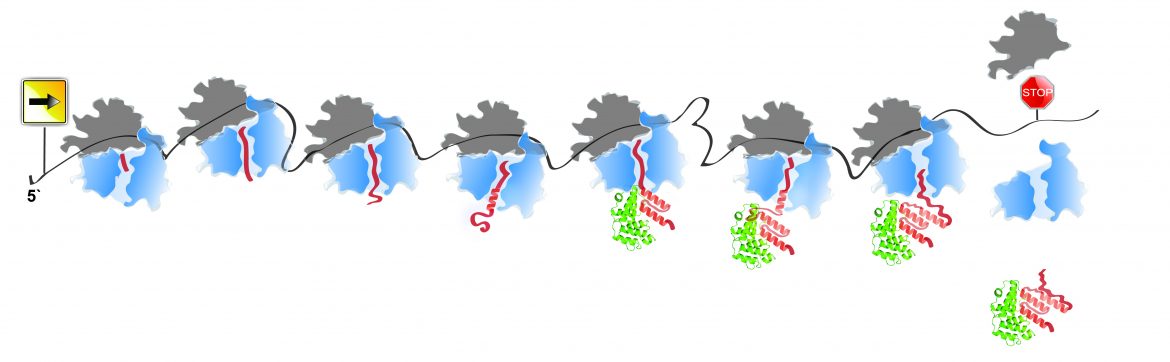
The majority of cellular proteins do not function alone; they often act together in complexes to achieve concerted functions. Despite the prevalence of protein complexes, very little is known about the mechanisms that ensure their correct folding and assembly. The importance of the folding and assembly challenge is underscored by the growing number of misfolding diseases, such as Alzheimer’s and Parkinson’s. All of these are characterized by the accumulation of misfolded proteins in aggregates.
Here we study how proteins form, fold, and assemble into functional complexes in our cells and what mechanisms facilitate and protect them from aggregation, neurodegeneration, and aging.
Our key questions
01
How are nanomachines formed in our cells?02
How do ribosomes go beyond synthesis to direct the polypeptide-chain folding and assembly?03
How do “lonely” proteins find their complex and pathway partners?04
What co-translational mechanisms protect proteins from misfolding?05
What co-translational mechanisms degrade “lonely” proteins?06
Does mRNA subcellular organization facilitate complex assembly?Our methods
Next-Generation Sequencing
Biochemistry & cell biology (yeast and cell cultures)
Selective Ribosome Profiling
smFISH
Single-molecule capture of protein-mRNA interactions
Polysome profiling
Proteomics of polysome fractions